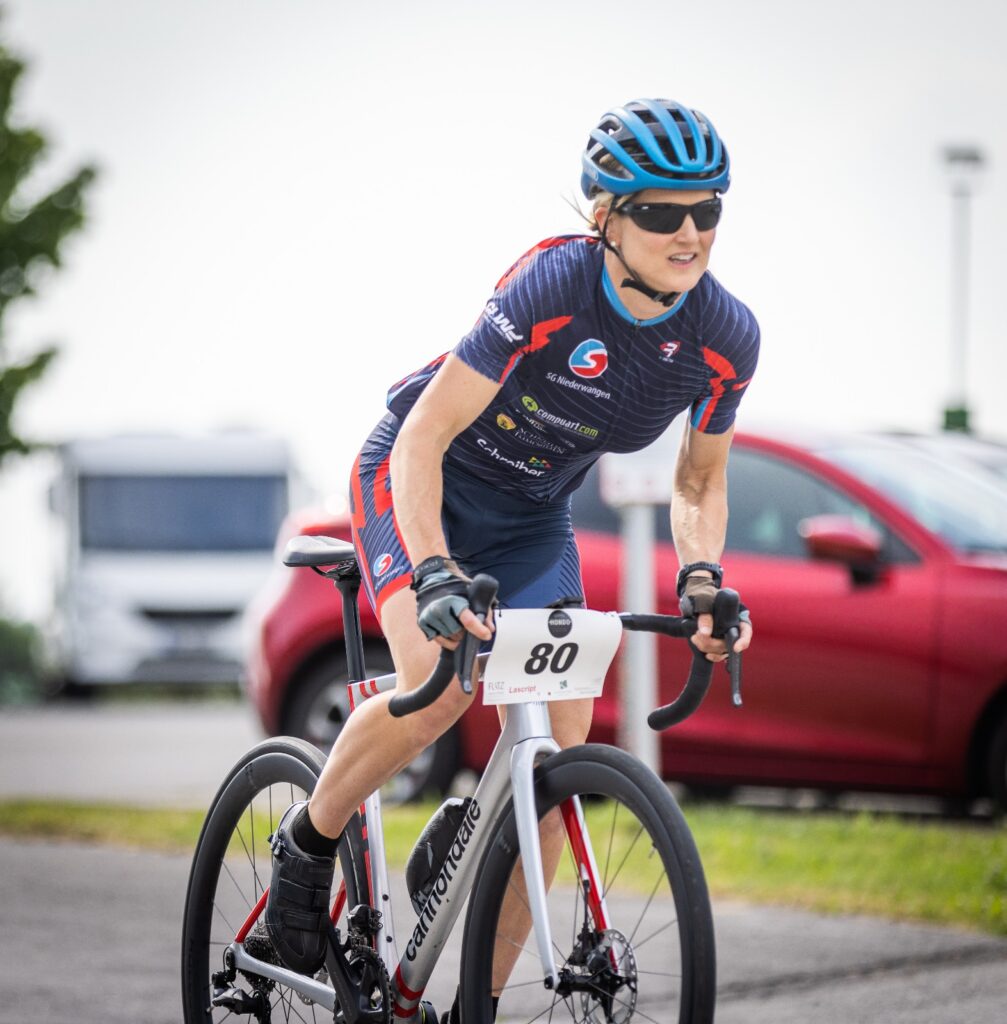
The Making of a World Champion: From Teacher and Mother of Three to Professional Triathlete
Most professional triathletes follow a familiar path. They begin racing at a young age, gradually progress through the ranks, and spend years developing before earning a professional license.
Steffi’s journey was different.
At 39 years old, she was a full-time teacher, the mother of three young boys, and balancing training around the realities of family life and a demanding career. Like many age-group athletes, she wasn’t searching for the perfect training environment—she was making the most of the one she had.
Throughout the winter and spring of 2022/23, nearly every outdoor run was completed while pushing a stroller, while many bike and strength sessions had to fit into the narrow window of her youngest son’s nap time. Her success wasn’t built on unlimited training hours. It was built on consistency, flexibility, and purposeful execution.
When Steffi first contacted me in late 2022, she had set two ambitious goals: competing at the ITU Sprint World Championships in Hamburg and, just five weeks later, at the Ironman 70.3 World Championships in Lahti. Preparing for two World Championship events with such different physiological demands required far more than simply increasing training volume. It demanded a carefully structured, individualized approach built around her physiology, lifestyle, and recovery.
What followed became far more than a successful race season. It became a powerful reminder that extraordinary performances aren’t reserved for athletes with unlimited time. They’re achieved by athletes who consistently execute the right training at the right time while balancing the demands of everyday life.
The Challenge
Every athlete arrives with a unique combination of strengths, limitations, responsibilities, and ambitions. Coaching isn’t about applying a standard training plan—it’s about understanding the individual standing in front of you.
Steffi possessed exceptional motivation, a strong work ethic, and years of training experience. Lack of commitment was never the limiting factor. Like many highly driven athletes, she genuinely loved to train and rarely needed encouragement to push herself.
That shaped my role as her coach. My responsibility wasn’t to convince Steffi to train harder—it was to ensure she was performing the right training at the right time. Every hard session needed a clear purpose, while every easier session created the conditions for the next meaningful adaptation.
Good coaching isn’t about constantly telling athletes to train less, nor is it about encouraging them to train more. It’s about understanding when additional training creates meaningful adaptation—and when it simply accumulates fatigue. The objective is to maximize every athlete’s potential by applying the right training stimulus at the right time while respecting the demands of everyday life.
As a full-time teacher and mother of three young boys, Steffi’s training had to coexist with family and professional responsibilities rather than compete against them. Recovery, flexibility, and communication became just as important as the workouts themselves.
From the beginning, regular blood lactate testing, objective performance data, and continuous communication guided every major training decision throughout the season. Every adjustment had one objective: helping Steffi arrive at both World Championship races healthy, confident, and performing at her highest level.
The following sections illustrate how this process unfolded—and why understanding the athlete is often far more valuable than simply prescribing more training.
Establishing the Baseline
Every successful coaching process begins with understanding the athlete—not making assumptions.
Rather than relying solely on race results or subjective impressions, I wanted to understand exactly how Steffi’s physiology was influencing her performance. Blood lactate testing provided an objective baseline from which every major training decision throughout the season would be made.
The goal wasn’t simply to make Steffi train harder. She was already highly motivated and willing to work. The objective was to improve the specific physiological qualities that would have the greatest impact on her performance while avoiding unnecessary fatigue from training that offered little additional benefit.
Our initial testing identified several key areas that would shape the direction of her training over the following months.
- Her Lactate Threshold 1 (LT1) was relatively low compared to her VO₂max, limiting her aerobic efficiency during longer races.
- Lactate clearance and metabolic flexibility could be improved, allowing her to produce more power while relying increasingly on aerobic metabolism.
- Her glycolytic contribution (VLamax / anaerobic power) was relatively high, reducing efficiency during prolonged endurance events.
Good coaching isn’t about finding ways to make athletes train more. It’s about identifying the training that creates the greatest adaptation while eliminating work that simply accumulates fatigue.
The timeline above illustrates how physiological development, carefully timed race preparation, and consistent communication came together over nearly two years. Performance improvements were not the result of a single breakthrough, but of hundreds of small, well-executed decisions made throughout the coaching process.
Balancing Two Very Different Goals
One of the most fascinating aspects of Steffi’s season was preparing for two World Championship races with dramatically different physiological demands—an ITU Sprint World Championship in Hamburg followed just five weeks later by the Ironman 70.3 World Championship in Lahti.
These weren’t simply two races on the calendar. They required two different performance profiles.
Sprint-distance racing rewards a high VO₂max, a powerful Lactate Threshold 2 (LT2), and the ability to repeatedly produce high-intensity efforts. In contrast, success in a 70.3 depends far more on aerobic efficiency, metabolic flexibility, and the ability to sustain a high percentage of LT1 while preserving muscle glycogen for a strong half-marathon.
The challenge wasn’t deciding which system to train—it was determining when to emphasize each physiological adaptation without compromising the other. This required careful planning, continual assessment, and regular adjustments throughout the season based on Steffi’s responses to training.
The physiological testing shown above became invaluable. Rather than guessing, we could objectively measure her development and confidently shift training priorities at the appropriate time.
Coaching Across Eight Time Zones
Distance was never a limitation.
Steffi lives in southern Germany—more than 5,800 miles (9,300 km) and eight time zones away from my home in the San Francisco Bay Area. Yet our communication was often more frequent than that of many coach-athlete relationships conducted in person.
By the time I started my workday each morning, Steffi had usually completed her training. I reviewed every session, analyzed the data, and provided detailed feedback through TrainingPeaks and WhatsApp voice messages. Throughout her day, she shared her observations, questions, and training feedback, allowing us to continually refine the plan based on both objective performance data and her physical and mental responses.
Successful coaching isn’t simply about writing workouts. It’s about building an ongoing dialogue that allows training to evolve alongside the athlete. Physiological testing provided the objective data, but communication gave that data meaning. Together, they became two of the cornerstones of Steffi’s remarkable progression throughout the season.
Training Environment
Although we worked remotely, Steffi had access to everything needed for high-quality training. Rather than relying on expensive technology alone, our focus was on using the right tools consistently and interpreting the data within the context of her physiology and everyday life.
- Smart trainer with power meter and heart rate monitoring.
- Indoor treadmill and outdoor running routes.
- 25 m indoor pool during winter and 50 m outdoor pool during summer.
- Home gym for strength training.
Measuring Progress, Not Guessing
Objective testing became one of the cornerstones of Steffi’s development. Rather than relying solely on race results or subjective feedback, regular blood lactate testing allowed us to objectively monitor physiological adaptation, confirm whether the training was producing the intended response, and confidently guide the next phase of her preparation.
Each assessment answered four essential coaching questions:
- Was aerobic efficiency improving?
- Was LT1 moving in the desired direction?
- Could training intensity be increased safely?
- Were we developing the physiological qualities required for the next target race?
Bike Development
One of our primary objectives was to improve Steffi’s aerobic efficiency while preserving the high-end power required for sprint racing. The physiological adaptations throughout the season were substantial.
- LT1 increased from 125W to 198W, allowing Steffi to produce significantly more power while relying increasingly on aerobic metabolism.
- LT2 improved from 211W to 235W, increasing her ability to sustain high race intensities with improved lactate clearance.
- These adaptations translated directly into race performance. At the Ironman 70.3 World Championships in Lahti, Steffi averaged 210 watts on the demanding, hilly bike course, completing the ride in 2:20—just five minutes behind the fastest professional women.
The objective wasn’t simply to increase power. It was to make more of that power aerobically sustainable, preserving valuable muscle glycogen for the half marathon.
Running Development
The improvements on the bike were mirrored by equally meaningful changes in Steffi’s running physiology.
Initial testing in November 2022 established the following baseline:
- LT1: 7:18 per mile
- LT2: 6:33 per mile
After months of carefully structured training, I repeated the blood lactate test one week before the Ironman 70.3 World Championships in Lahti.
- LT1: 6:52 per mile
- LT2: 6:06 per mile
These improvements reflected far more than increased running speed. They demonstrated greater aerobic efficiency and the ability to sustain faster paces at a lower metabolic cost—an essential requirement for running a strong half marathon after a demanding 90 km bike leg.
Bike blood lactate threshold tests
Run blood lactate threshold tests
LT1 represents the intensity at which the body transitions from using primarily fat for energy to increased carbohydrate use. It reflects your metabolic profile, metabolic efficiency, and aerobic capacity.
We were able to increase LT1 threshold pace significantly (4:36–>4:05/km) with aerobic conditioning training (Grundlagen-Ausdauer), which also helped to improve LT2 (4:06–>3:50/km), and V02max (new 5k PR !!).
LT1 pace dropped after a very intense race season (sprint, Olympic distance), however LT2 pace was successfully maintained.
Frequent high-intensity racing and training, particularly for sprint and Olympic-distance events, often prioritizes anaerobic and threshold efforts. This can lead to a decline in aerobic conditioning (LT1), as the focus shifts away from the sustained, lower-intensity training that supports aerobic development.
Over a 3-month period of racing and peak training, a drop in LT1 was observed, reflecting the cost to aerobic conditioning. However, thanks to consistent aerobic-focused sessions incorporated during this time, we were able to slow down what could have been a much steeper decline in LT1.
This highlights the importance of balancing high-intensity demands with regular aerobic base-building to maintain overall metabolic efficiency and long-term endurance performance.
The Training Strategy
Once Steffi’s physiological profile was clearly understood, every training block had a specific objective. Rather than simply increasing training volume, the focus was on developing the physiological qualities that would have the greatest impact on her two very different World Championship races.
- Build a Strong Aerobic Engine
VO₂max formed the foundation for both sprint and 70.3 racing. We developed aerobic capacity while improving functional utilization, allowing Steffi to sustain a greater percentage of her aerobic potential during competition. - Improve Metabolic Efficiency
As the focus shifted toward Ironman 70.3 preparation, increasing LT1 became a priority. The objective was to produce higher power outputs and faster running speeds while relying more heavily on aerobic metabolism and preserving valuable muscle glycogen for the run. - Maintain Speed Without Overdeveloping Anaerobic Capacity
Steffi naturally possessed excellent anaerobic power. Rather than continually developing that strength, we carefully balanced high-intensity work while minimizing unnecessary glycolytic development that could compromise long-course performance. - Adapt the Training Throughout the Season
Preparing for both a Sprint World Championship and a 70.3 World Championship required continual adjustments. Training emphasis shifted throughout the season so that each phase built upon the previous one without compromising either goal.
Designing effective workouts was only part of the coaching process. Equally important was fitting those workouts into Steffi’s life. As a full-time teacher and mother of three young boys, training had to complement—not compete with—her professional and family responsibilities. Flexibility, recovery, and ongoing communication allowed us to maintain consistency throughout the season while ensuring she arrived healthy, confident, and ready to perform when it mattered most.
The Results
Physiological improvements only matter if they translate into race-day performance. Throughout 2023—and continuing into 2024—the progress measured through training and physiological testing consistently appeared where it mattered most: in competition.
ITU Sprint World Championships – Hamburg
Only months after beginning our work together, Steffi competed at the ITU Sprint World Championships in Hamburg. Her improved aerobic capacity, higher LT2, and ability to repeatedly sustain high-intensity efforts allowed her to excel in one of the sport’s fastest and most demanding race formats, earning a World Championship medal.
Ironman 70.3 World Championships – Lahti
Five weeks later came an entirely different challenge.
The physiological adaptations developed throughout the season became evident during the bike leg, where Steffi produced one of the strongest rides of the day, arriving in T2 with an extraordinary ten-minute lead over the second-place athlete.
Then everything changed.
Early in the run, Steffi rolled her ankle on a steep wooden ramp and crashed hard. She immediately realized something was wrong. Despite the pain and uncertainty, she refused to let months of preparation be defined by one unfortunate moment.
Drawing on the advantage she had built during the swim and bike, Steffi persevered through the remainder of the race to become the new Ironman 70.3 World Champion.
It wasn’t a perfect race.
It was a demonstration of resilience.
Continuing the Progress
Steffi’s development didn’t stop with her World Championship victory.
In 2024 she won the prestigious Pfänder Hill Climb in Austria, covering the 6 km ascent in 25:22 while averaging an exceptional 295 watts (5.13 W/kg). The performance also earned her the STRAVA Queen of the Mountain title.
To put that performance into perspective, she improved her own winning time from the previous year by more than two minutes and finished 61 seconds ahead of professional cyclist Liane Lippert (Movistar), who placed fourth at the 2024 UCI Road World Championships.
More Than Results
Looking back, the most remarkable part of Steffi’s story isn’t that she became a World Champion or later earned her professional triathlon license.
It’s that she achieved those goals while balancing the responsibilities of teaching, raising three young children, and training within the realities of everyday life.
Her success wasn’t built on unlimited training hours or extraordinary shortcuts. It was built on consistent execution, intelligent physiological testing, open communication, and hundreds of well-executed decisions made over many months.
For me, that’s what coaching is ultimately about.
Not helping athletes train harder—but helping them train with purpose, adapt with confidence, and discover capabilities they may never have believed possible.
Elite Race results 2023
- 1st Half-Marathon Bludenz, Austria (4-30-2023)
- 1st 10km Bad Waldsee,Germany (5-20-2023)
- 1st Pfaender Climb TT,Austria (6-4-2023)
- 1st Bregenzer Triathlon Olympic Distance (6-18-2023)
- 1st Erbacher Triathlon Sprint (6-25-2023)
- 2nd AG ITU Sprint WC, Hamburg (7-14-2023)
- 1st ITU WC Team Germany (7-16-2023)
- 1st Ravensburger Sprint Triathlon (8-5-2023)
- 1st Janner Tri, Lustenau, Austria (8-12-2023)
- 1st AG 70.3 WC Lahti, Finland (8-26-2023)
A New Chapter
For most athletes, winning a World Championship represents the culmination of years of dedication—the perfect ending to an unforgettable season.
For Steffi, it marked the beginning of something entirely new.
By the end of 2023, she had enjoyed one of the most successful seasons imaginable, standing on podiums across triathlon and cycling while consistently demonstrating the physiological progress we had measured throughout the year.
With both an ITU Sprint World Championship medal and the Ironman 70.3 World Championship title behind her, our conversations naturally shifted toward a question that would have seemed almost unimaginable only a few years earlier.
Could Steffi compete as a professional triathlete?
Having coached world champions throughout my career, including Leanda Cave, I believed she had the potential.
What convinced me wasn’t simply her race results. It was the combination of her physiology, her remarkable rate of improvement, her consistency, and the fact that she had achieved these performances while balancing family life, teaching, and a relatively modest training volume. The data suggested there was still considerable room for development.
After many conversations—and with the full support of her husband, Juergen—Steffi decided to apply for her professional license.
It wasn’t a decision driven by expectations or external pressure. It was driven by curiosity.
“What might be possible if we continued?”
That simple question became the foundation for everything that followed.
Throughout the decision-making process, Steffi often returned to one simple belief.
“If you don’t try, you’ll never find out what’s possible.”
That mindset ultimately transformed one extraordinary season into the beginning of an entirely new career.
Building on Success
Steffi’s World Championship victories in 2023 were never intended to be the destination. They became the foundation for the next stage of her athletic development.
Her debut professional season confirmed what the data had suggested all along—she belonged among the world’s best long-distance triathletes. Throughout 2024, Steffi continued to produce outstanding performances, demonstrating that her success was no coincidence but the result of years of consistent, purposeful training.
One of the highlights came at the Ironman European Championships in Hamburg, where she made her full-distance Ironman debut. She recorded an exceptional 4:29 bike split over the 180 km course—one of the fastest bike performances by any professional woman during the 2024 Ironman season—and broke the prestigious 9-hour barrier in her very first attempt at the distance.
Just five weeks later, she lined up again at Challenge Roth and delivered another outstanding performance, recording a 4:35 bike split and another finish under nine hours.
For me as her coach, these performances reinforced something I had believed from the beginning. When physiology, intelligent planning, consistent communication, and an athlete’s unwavering commitment come together, remarkable performances become possible.
Lessons Beyond the Results
Steffi’s story is extraordinary, but the principles behind her success are universal.
- Understand the athlete before prescribing the training.
- Measure physiology instead of relying on assumptions.
- Build consistency before chasing intensity.
- Communicate openly and adapt training as life changes.
- Extraordinary performances are rarely built on extraordinary workouts—they’re built through hundreds of well-executed decisions made consistently over months and years.
Every athlete’s path is different. Whether the goal is completing a first Sprint triathlon, qualifying for a World Championship, or competing professionally, the coaching process remains the same: understand the athlete, apply the right training at the right time, and continually adapt as fitness—and life—evolve.
Extraordinary performances are rarely built on extraordinary workouts. They’re built through hundreds of well-executed decisions made consistently over months and years.
That’s the philosophy that continues to guide every athlete I coach.
If Steffi’s story resonated with you, I invite you to learn more about The T3 Method, explore my Triathlon Coaching services, or get in touch to discuss your own goals. Whether you’re preparing for your first Sprint triathlon or pursuing a World Championship, the coaching process always begins the same way: understanding the athlete.
Pro/elite Race results 2024
- Ryllauf HM in New PR 1:20hrs (3-17-2024)
- IM Hamburg 8:57hrs (6-2-2024)
- 1st Pfaender climb TT,Austria (6-20-2024)
- 3rd Laufcup 8k hilly (6-27-2024)
- Challenge Roth 9:00hrs (7-7-2024)
- 3rd Laufcup 13k (7-25-2024)
- 2nd Ravensburg Sprint (8-3-2024)
- 1st BaWue Road Championships Elite TT 5.6w/kg (8-4-2024)
- 1st Janner Tri, Lustenau, Austria (8-10-2023)
- 3rd Allgaeu Triathlon 2k-80k-20k (8-18-2023)
- 19th 70.3 Zell a. See (9-1-2024)
- 2nd Elite Chur-Arosa Climbing road race (9-8-2024)
- 3rd Laufcup (9-19-2024)
- 3rd Lindau Half-Marathon 1:22:35h (10-13-2024)
- 1st Niederwangener 12k (10-06-2024)