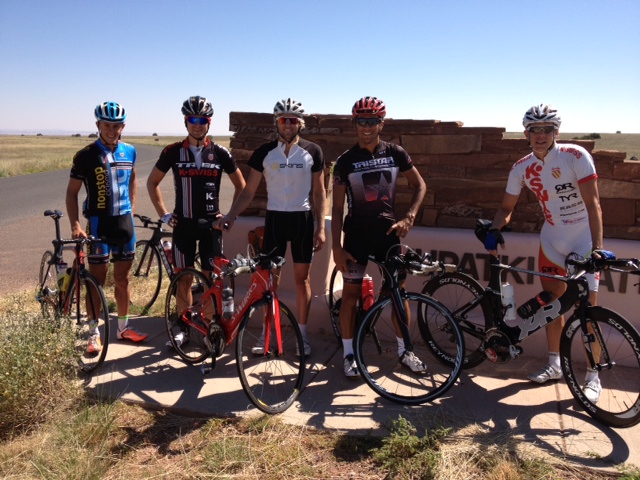
(above picture) a 240 km training ride in Arizona with Fraser Cartmell, Chris McCormack, Cameron Good and Declan. I learned a great deal simply by being around athletes who trained at a very high level—watching, listening, and paying attention.
The Work That Makes the Athlete
The fundamentals I learned through decades of training, racing, traveling, observing elite athletes, and paying attention.
I learned much of what I know about endurance training by watching, doing, and paying attention.
As a young triathlete, I was fascinated by how the best athletes trained. I read whatever I could find. I watched what the better German triathletes around me were doing. I paid attention to how much they trained, how they organized their weeks, how they recovered, and what happened when they pushed their limits.
My education didn’t come from one coach, one training system, or one country. It came from years of moving through different training environments and paying attention to what the best athletes around me were doing.
I trained in high-performance environments in Southern France, Bath and Swansea in the UK, Hong Kong, and Australia. I spent time training with an elite swim squad at the University of Queensland in Brisbane. I trained and raced across Europe, Australia, Asia and the United States.
I watched elite German triathletes train. I observed swimmers, cyclists and runners from different backgrounds. I talked with coaches from Germany, England, Scotland, Australia, Switzerland and New Zealand.
Different countries. Different philosophies. Different athletes. Different approaches.
And somewhere in all of that, I started to recognize what kept showing up.
The fundamentals.
Build the aerobic engine.
Develop strength.
Learn the skills.
Go very fast sometimes.
Recover.
Pay attention.
Execute.
Repeat.
Looking back now, one pattern is hard to miss:
The athletes who continued to improve weren’t necessarily the ones who trained hardest every day. They were the ones who developed the capacity to do a lot of good training—and then kept doing it.
That sounds simple.
It isn’t.
Learning how much work you can handle, where your aerobic threshold lies, when intensity is useful, how to become stronger without simply accumulating fatigue, and how to fit training around the rest of your life takes years of experience.
And that is probably the biggest lesson my own athletic career has given me:
Endurance performance is built less by individual heroic workouts than by what you are able to repeat.
That idea has stayed with me throughout my career—from professional racing to more than two decades of coaching athletes with very different goals, abilities and lives.
1. Aerobic Threshold Endurance
One of the first things I had to understand was that being willing to work hard wasn’t enough.
When you’re motivated, competitive and relatively young, hard training feels productive.
You finish exhausted.
You know you worked.
And it can be very satisfying.
But endurance athletes eventually have to ask a different question:
How much useful training can I absorb?
That question changed my understanding of training.
If you want to train consistently for months and years, you cannot treat every session as a test of your maximum ability.
You need an aerobic foundation that allows you to accumulate work without constantly digging yourself into a hole.
This is one reason aerobic threshold became such an important concept in my own training and later in my coaching.
The goal isn’t simply to become better at going hard.
It is to develop the ability to produce energy aerobically, sustain work efficiently and recover well enough to do it again.
The more training I accumulated, the more I appreciated the difference between intensity that creates useful adaptation and intensity that simply creates fatigue.
And this is where physiological testing can become valuable.
Today, I use blood lactate testing and other performance data to help understand where an athlete’s aerobic and higher-intensity domains actually sit.
The test isn’t the answer.
It is information.
The coach’s job is to turn that information into better decisions.
2. Volume Is Not the Goal. Capacity Is.
During my professional years, I eventually learned to tolerate very large training loads.
But the important part wasn’t simply accumulating hours.
It was developing the capacity to absorb those hours.
Week after week.
Month after month.
Season after season.
That meant learning how to train when I wasn’t completely fresh.
It meant learning how much recovery I needed.
It meant eating enough.
Sleeping enough.
Backing off when necessary.
And learning the difference between productive fatigue and the kind of fatigue that slowly breaks you down.
This is something I still emphasize with athletes today.
Training volume is a tool.
It isn’t a badge of honor.
A 20-hour training week isn’t automatically better than a 10-hour week.
The question is:
What can this athlete actually absorb and adapt to?
Two athletes can have the same goal and require completely different training.
One may thrive on more volume.
Another may improve with less.
One may have the time and recovery capacity to train twice a day.
Another may have a demanding job, children, travel or other responsibilities that make that approach unrealistic.
Good coaching starts with understanding the athlete who actually exists—not the athlete we wish existed on paper.
3. Strength Gives You Something to Back Up
As my training developed, strength became increasingly important.
Not simply because I wanted to lift more weight.
Strength had to transfer into endurance performance.
On the bike.
In the water.
Running uphill.
Holding position.
Producing power late in a race.
Maintaining mechanics when fatigue accumulated.
That distinction is important.
I don’t believe in making athletes tired simply for the sake of making them tired.
The question should always be:
What type of fatigue is useful?
Strength should have a purpose.
For one athlete, that might mean traditional strength training.
For another, it might mean hill running.
For another, big-gear cycling.
For a swimmer, paddles, bands or other forms of resistance may provide an appropriate stimulus.
The method can change.
The principle doesn’t:
Become strong enough to do the work you are asking your body to do.
Strength can help increase race pace.
It can improve durability.
It can help an athlete maintain mechanics under fatigue.
And perhaps most importantly, it gives you something to back up.
You might be able to produce a great effort once.
The better-trained athlete can produce it again.
And again.
And again.
4. You Still Have to Learn How to Race
Fitness doesn’t automatically make you a good racer.
I learned this through years of competition.
Racing teaches you things that training cannot completely reproduce.
How to position yourself.
How to pace.
When to respond.
When not to respond.
How to deal with someone attacking.
How to stay calm when you’re hurting.
How to recognize the difference between this hurts and I’m actually in trouble.
And perhaps most importantly:
How to keep executing when the race isn’t going according to plan.
There are lessons available in competition that simply aren’t available in a controlled training session.
You learn how your body responds when the stakes are higher.
You learn what happens when someone else changes the pace.
You learn how your perception of effort changes when you’re racing rather than training.
You learn how to make decisions while tired.
These are skills.
And skills need to be practiced.
That’s why I still believe that racing is a skill.
You develop it by racing.
5. Go Very Fast — Sometimes
The other side of aerobic development is that endurance athletes shouldn’t become afraid of intensity.
Most training doesn’t need to be hard.
But some training should be.
Occasionally, you need to find out what happens when you go very fast.
You need to experience discomfort.
You need to learn what maximum effort feels like.
You need to discover that some of the limits you perceive are not necessarily your actual limits.
Some of my most valuable training experiences came from sessions where I went harder than I thought I could.
Not because I needed more suffering.
Because I learned something.
That’s the distinction.
Intensity should teach you something.
It shouldn’t simply leave you exhausted.
There is a time to develop the aerobic system.
There is a time to develop strength.
And there is a time to challenge the athlete’s ability to produce high power, high speed or high intensity.
The art is knowing when each one belongs.
6. Consistency Beats Heroics
This may be the most important lesson of all.
Anyone can have a great workout.
Anyone can suffer for an hour.
Anyone can produce a huge training week once.
The real question is:
Can you do it again?
And again.
And again.
That’s where development happens.
The athlete who trains at 95% of what they can consistently sustain will usually go much further than the athlete who repeatedly tries to train at 110%.
This is one reason I’ve become increasingly interested in execution as a coaching concept.
A training plan is a theory.
Execution gives us the answer.
You can write the perfect week on paper.
But if the athlete can’t execute it because of work, family, stress, poor recovery, an unrealistic schedule—or simply because too much has been put into the plan—the plan doesn’t matter.
The plan has to survive contact with real life.
That’s one of the reasons I don’t believe coaching should be about demanding perfect adherence.
It should be about understanding why execution breaks down and making a better decision from there.
Aim High. Leave Something in Reserve.
Don’t Chase 100% Every Day
I’ve learned to be suspicious of perfection.
The goal isn’t to execute every workout perfectly.
It isn’t to hit every metric every week.
And it certainly isn’t to prove how tough you are.
The goal is to create a training process that can continue.
That means occasionally doing less.
It means adjusting.
It means recovering.
It means accepting that life happens.
And sometimes it means going into the discomfort zone because that’s what development requires.
Sustainable doesn’t mean easy.
That’s an important distinction.
Sustainable training can be extremely demanding.
It can hurt.
It can require discipline.
It can require sacrifices.
But the stress is purposeful and recoverable.
That’s very different from constantly digging a hole and calling it commitment.
What I Didn’t Understand in the Beginning
When I look back at myself as a young athlete, I don’t see someone who lacked motivation.
I lacked understanding.
I had to learn through experience.
I had to learn what my body could handle.
I had to learn how much recovery I needed.
I had to learn that more wasn’t always better.
I had to learn that sometimes the most productive workout was the one I didn’t do.
And I had to learn that fitness is not the same thing as performance.
Those lessons took years.
That’s why I don’t believe athletes should expect to understand their physiology, their optimal training load and their competitive potential after a few months of training.
You’re building an apprenticeship.
Every workout gives you information.
Every race gives you information.
Every setback gives you information.
Every breakthrough gives you information.
If you’re paying attention, you’re constantly learning.
And that is one of the most valuable things endurance sport can teach us.
This Is Still How I Coach
My coaching methodology has become much more sophisticated since those early years.
Today I can use blood lactate testing, TrainingPeaks data, power, heart rate, running metrics, movement analysis and other tools to help understand what is happening.
But technology hasn’t changed the fundamentals.
I’m still asking the same questions I eventually learned to ask myself:
What does this athlete need?
What can they absorb?
What is limiting them?
What should we develop next?
And can they actually execute the plan within the life they are living?
That’s where coaching becomes more than prescribing workouts.
It’s about understanding the athlete.
It’s about paying attention.
It’s about making better decisions.
And ultimately, it’s about helping the athlete develop enough fitness, awareness and trust to perform when it matters.
The Work That Makes the Athlete
I’ve been in endurance sport for more than three decades.
I’ve trained as a professional athlete.
I’ve coached for more than 20 years.
I’ve seen training philosophies come and go.
I’ve watched technology transform the sport.
And I’ve learned more from athletes than I could ever have learned from a textbook alone.
But some things remain remarkably consistent.
Build the aerobic engine.
Develop strength.
Learn to race.
Go very fast sometimes.
Recover.
Pay attention.
Execute.
Repeat.
The athlete’s goals may change.
The available time may change.
The physiology may change.
Life certainly changes.
But the fundamental challenge remains the same:
Can we consistently do the right work, for long enough, to become the athlete we want to become?
That’s the question I’ve been trying to answer since I started.
And it’s still the question I ask every athlete I coach today.