
Running Gait Analysis

Every runner has a unique movement pattern. Small inefficiencies in running mechanics can reduce performance, increase fatigue, and contribute to recurring injuries—even in experienced athletes.

My in-person Running Gait Analysis combines high-speed video analysis with real-time coaching to identify movement patterns, improve running economy, and help you move more efficiently with every stride.

Small Improvements.
Meaningful Performance Gains.

Running economy isn’t determined by fitness alone. Better movement improves efficiency, reduces unnecessary stress, and helps you perform at your best. Small improvements in running mechanics can produce meaningful gains in efficiency, comfort, and long-term durability.

Why Running Form Matters

Many athletes assume performance is limited by fitness alone. In reality, inefficient movement patterns often waste energy, reduce running economy, and increase the stress placed on muscles, tendons, and joints.

Even highly trained runners can develop subtle compensations over time—especially during periods of heavy training, after injury, or as fatigue sets in during racing.

The goal isn’t to create a perfect running style. The goal is to help you move more efficiently by reducing unnecessary movement, improving running economy, and helping you stay healthy enough to train consistently.

See how slow-motion video analysis helps identify movement patterns that are difficult to detect at full running speed. During every assessment, you’ll receive immediate coaching feedback and practical recommendations you can begin applying right away.

Who Is This Assessment For?

Whether you’re preparing for your first race, chasing a personal best, or simply trying to stay injury-free, understanding how you move is one of the most valuable investments you can make in your running.

Triathletes

Improve running economy off the bike, reduce late-race fatigue, and identify movement patterns that become more pronounced during long-course racing.

Road & Marathon Runners

Improve efficiency, reduce unnecessary braking forces, and develop smoother mechanics that support faster, more economical running.

Returning From Injury

Identify movement compensations that may contribute to recurring issues involving the Achilles, calves, knees, hips, hamstrings, or lower back.

HYROX & Performance Athletes

Improve running efficiency under fatigue while identifying movement limitations that reduce performance during repeated high-intensity efforts.

There Is No Perfect Running Style.

The goal isn’t to make every athlete run the same way. It’s to help you move more efficiently with the body you have—reducing unnecessary movement, improving running economy, and staying healthy enough to train consistently.

What Happens During Your Assessment?

This isn’t simply a video recording session. Every assessment combines observation, movement analysis, real-time coaching, and practical feedback you can immediately apply to your running.

STEP 1

Initial Observation

We begin by observing your natural running mechanics before making any recommendations. This provides an authentic picture of how you move under normal running conditions.

STEP 2

High-Speed Video Analysis

Multiple camera angles allow us to review every stride frame by frame, making subtle movement patterns visible that are impossible to detect at full running speed.

STEP 3

Real-Time Coaching

You’ll receive immediate coaching cues and practical adjustments during the session, allowing you to feel the difference while you’re running—not days later.

STEP 4

Your Action Plan

You’ll leave with clear priorities, individualized drills, strength recommendations, practical coaching cues, and a plan you can immediately apply to your training.

You Leave With More Than Just Video

The goal isn’t simply to identify what’s happening. It’s to understand why it’s happening—and what to do next.

✓ High-speed video review
✓ Individual movement assessment
✓ Running form coaching cues
✓ Immediate practical feedback
✓ Individual strength recommendations
✓ Corrective running drills
✓ Injury risk reduction strategies
✓ Greater confidence in your running

Running Gait Analysis & Performance Assessment

A comprehensive one-on-one assessment designed to help you move more efficiently, reduce injury risk, and improve your running performance through expert analysis and practical coaching.

$225

60-minute Run Form & Gait Analysis

Your Assessment Includes

✓ Initial consultation & training review
✓ High-speed video analysis
✓ Front, rear & side-view assessment
✓ Running mechanics evaluation
✓ Cadence & stride analysis
✓ Real-time coaching feedback
✓ Individual running drills
✓ Strength recommendations
✓ Personalized action plan
✓ Follow-up video clips & written summary

Preferred Pricing for Active T3 Coaching Athletes

$175

Available to athletes currently enrolled in a T3 coaching program.

Location & Travel

Assessments are available throughout Marin County and the San Francisco Bay Area. Sessions are typically conducted at local tracks, quiet roads, or other suitable outdoor locations where your natural running mechanics can be evaluated.

Travel within my local service area is included. Sessions requiring extended travel may incur a modest travel fee depending on distance and travel time. Any additional fee will always be discussed and agreed upon before your appointment.

See How Better Running Begins

Whether you’re looking to improve running economy, reduce injury risk, or simply understand your movement more clearly, a professional Run Form & Gait Analysis provides objective insight, immediate coaching feedback, and practical strategies you can apply from your very next run.

Schedule Your Assessment →

Questions before booking?
Prefer email? Reach me directly at

torsten@torstentri.com


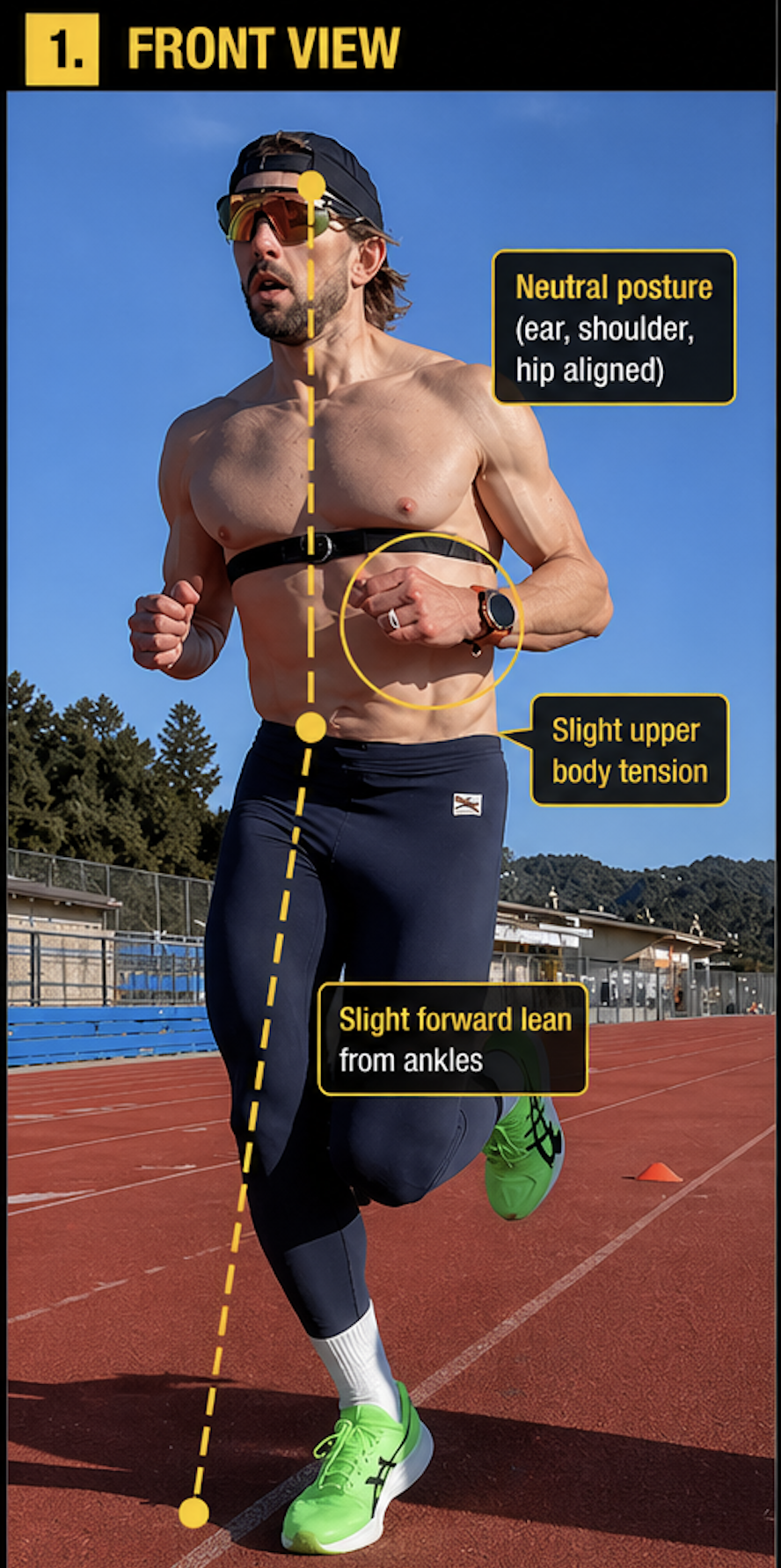
Front View Analysis (Alignment & Control)

The front view provides valuable insight into how your body controls movement with every stride. Rather than focusing on one isolated joint, we assess how the feet, knees, hips, and pelvis work together to create efficient, balanced running mechanics. Small asymmetries often become more noticeable as fatigue sets in and may contribute to unnecessary stress on muscles and joints.
What We Assess

  • Hip stability — the foundation for efficient running mechanics and long-term durability.
  • Knee tracking — ensuring the knees move efficiently through each stride without excessive inward or outward movement.
  • Foot alignment — evaluating how the feet land and support the body throughout ground contact.
  • Left vs. right symmetry — identifying movement differences that may contribute to inefficiency or recurring overload.
  • Lateral movement — assessing unnecessary side-to-side motion that can waste energy over longer distances.

Why It Matters

Efficient runners don’t simply generate more power—they control movement more effectively. Better alignment and stability help reduce unnecessary stress, improve running economy, and support more consistent performance throughout training and racing.
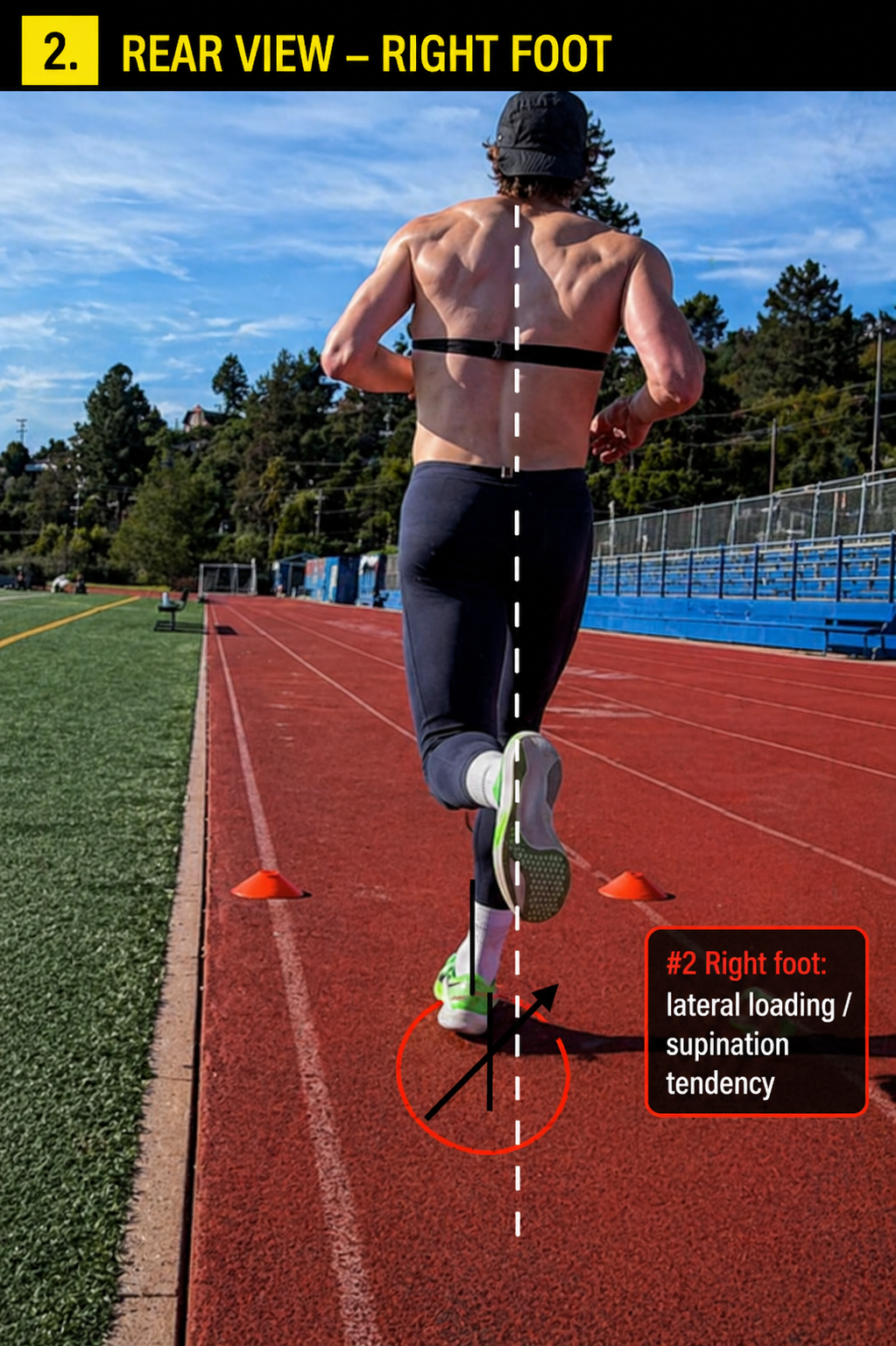
Rear View Analysis (Stability & Symmetry) The rear view provides valuable insight into how your body controls movement from one stride to the next. It allows us to evaluate how your feet, ankles, knees, hips, and pelvis work together while supporting your body weight. Small asymmetries and compensations often become more noticeable from behind—especially as fatigue develops during longer runs or races. What We Assess
  • Foot placement & loading — how each foot lands beneath the body and absorbs force during ground contact.
  • Ankle stability — identifying excessive inward or outward movement that may reduce efficiency.
  • Knee tracking — evaluating whether each knee remains stable throughout the stance phase.
  • Hip stability — assessing pelvic control and identifying excessive hip drop or compensatory movement.
  • Left vs. right symmetry — comparing both sides to identify imbalances that may contribute to recurring injuries or reduced efficiency.
  • Overall movement control — evaluating how efficiently your body transfers force from one stride to the next.
Why It Matters Efficient runners don’t simply produce more power—they control movement more effectively. Better stability and symmetry help reduce unnecessary stress, improve running economy, and support consistent performance throughout training and racing.
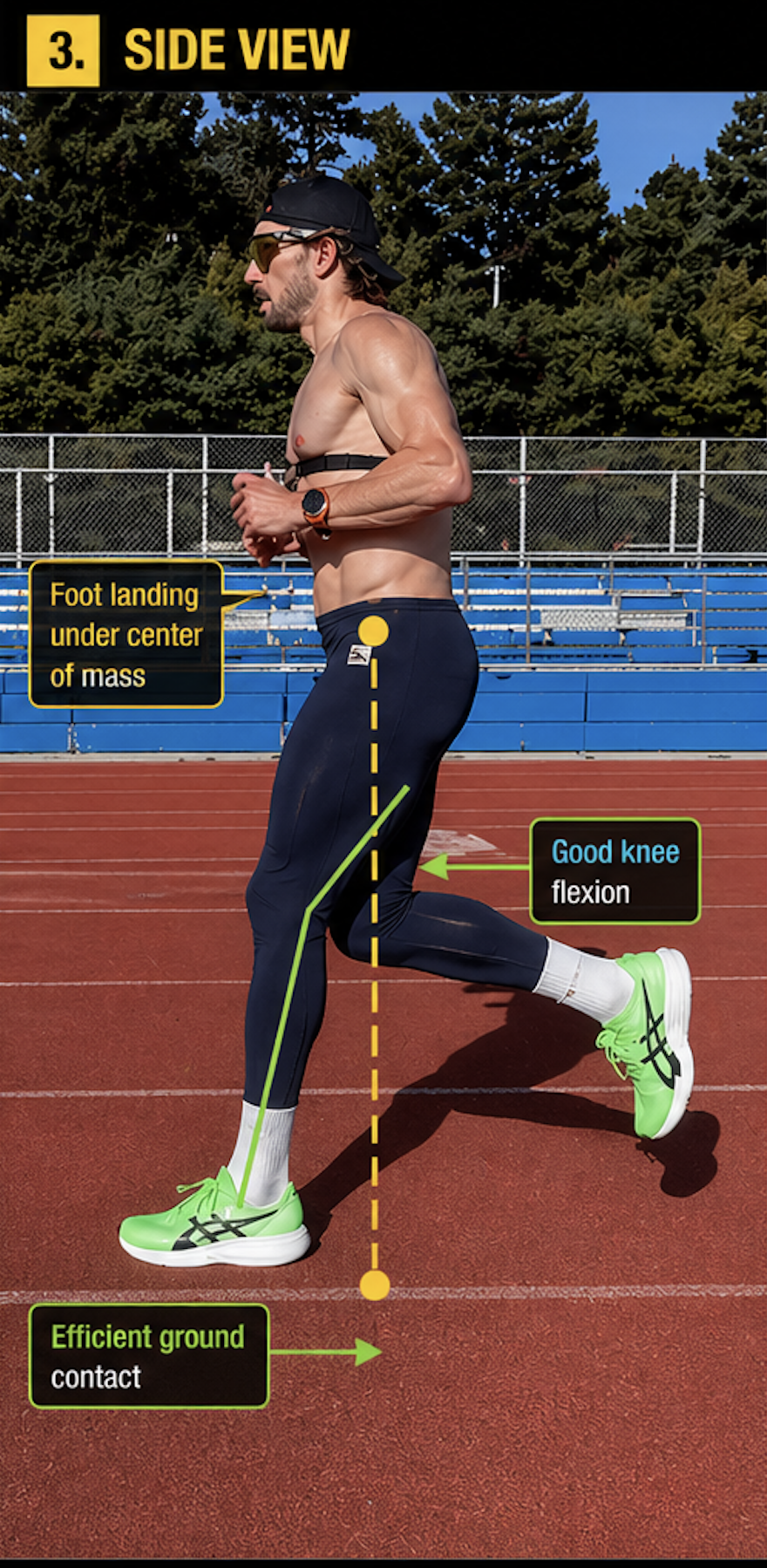
Side View Analysis (Running Economy & Efficiency) The side view allows us to evaluate how efficiently you move forward with each stride. It provides valuable insight into stride length, cadence, foot placement, posture, and how effectively your body converts energy into forward motion. Small inefficiencies from this angle can have a significant impact on running economy over longer distances. What We Assess
  • Foot placement — evaluating where the foot lands in relation to your center of mass.
  • Stride length — identifying whether your stride promotes efficient forward movement without unnecessary braking.
  • Cadence — assessing step frequency and its influence on efficiency and impact forces.
  • Running posture — evaluating body position and forward lean throughout the stride cycle.
  • Vertical oscillation — identifying unnecessary up-and-down movement that wastes energy.
  • Push-off mechanics — assessing how effectively force is generated and transferred into forward propulsion.
Why It Matters Running faster isn’t always about producing more power. Often it’s about using less energy to maintain the same pace. Improving running economy helps reduce fatigue, increase efficiency, and allows you to sustain your performance over longer distances with less effort.